PERSPECTIVE
Amgen’s November 11 Phase 3 readout gives new momentum to an old idea: blocking CD40 ligand, a signal that helps activate immune cells. In Sjögren’s disease, a chronic autoimmune disorder, the immune system attacks the glands that make tears and saliva. Patients can also experience fatigue, joint pain and damage to organs such as the lungs and kidneys.
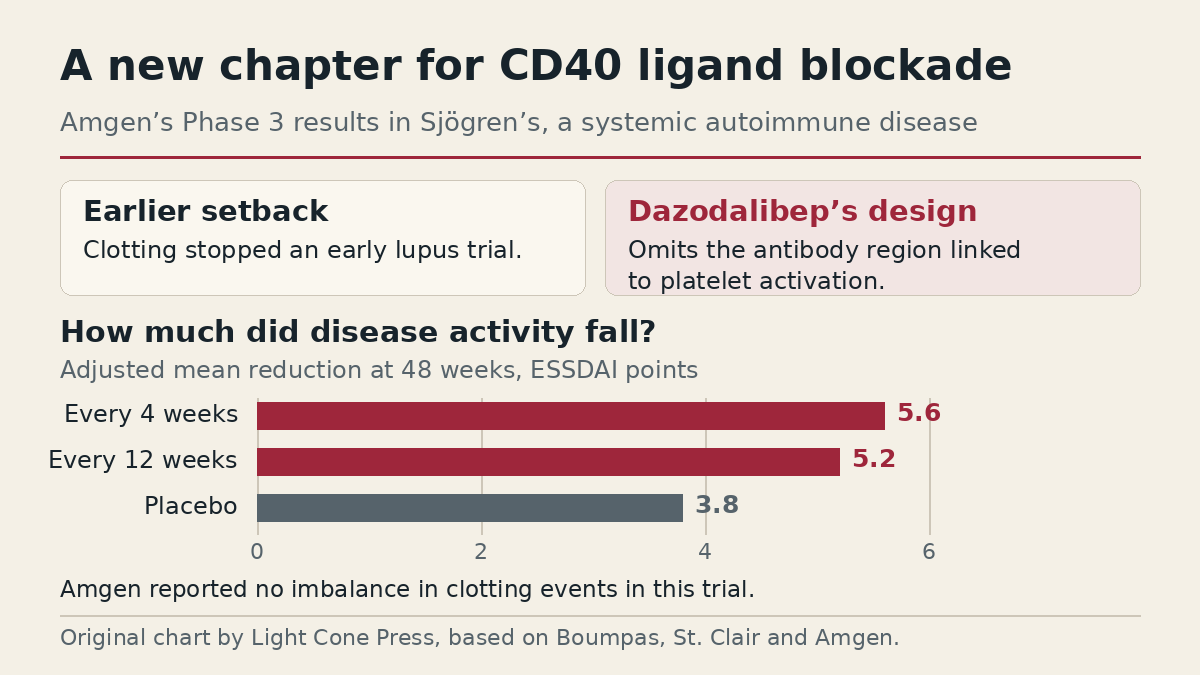
Early antibodies against CD40 ligand ran into clotting problems. A lupus kidney disease trial stopped early after thromboembolic events, including two heart attacks in that study. IDEC also put its anti-CD40 ligand trials on hold. Dazodalibep is a fusion protein designed without the antibody region implicated in platelet activation. A different CD40 ligand blocker met its primary endpoint in a Phase 3 lupus trial published this year.
In Amgen’s 648-person trial, both dosing schedules reduced systemic disease activity more than placebo at 48 weeks, by 1.8 and 1.4 points on the trial’s disease activity scale. Patients on the four-week schedule also reported less dryness than those on placebo. Amgen reported no imbalance in clotting events across groups. Longer follow-up and a separate trial in patients with substantial symptoms but less systemic disease will help clarify long-term safety and who may benefit.
ORIGINAL SOURCES
- Amgen Phase 3 OASIZ-301 results, November 11, 2026
- NIH overview of Sjögren’s disease
- Boumpas et al., early anti-CD40 ligand lupus nephritis trial, 2003
- IDEC Pharmaceuticals Form 10-Q, IDEC-131 trial hold
- St. Clair et al., dazodalibep design and Phase 2 study, 2024
- UCB and Biogen, Phase 3 lupus publication and results, 2026