PERSPECTIVE
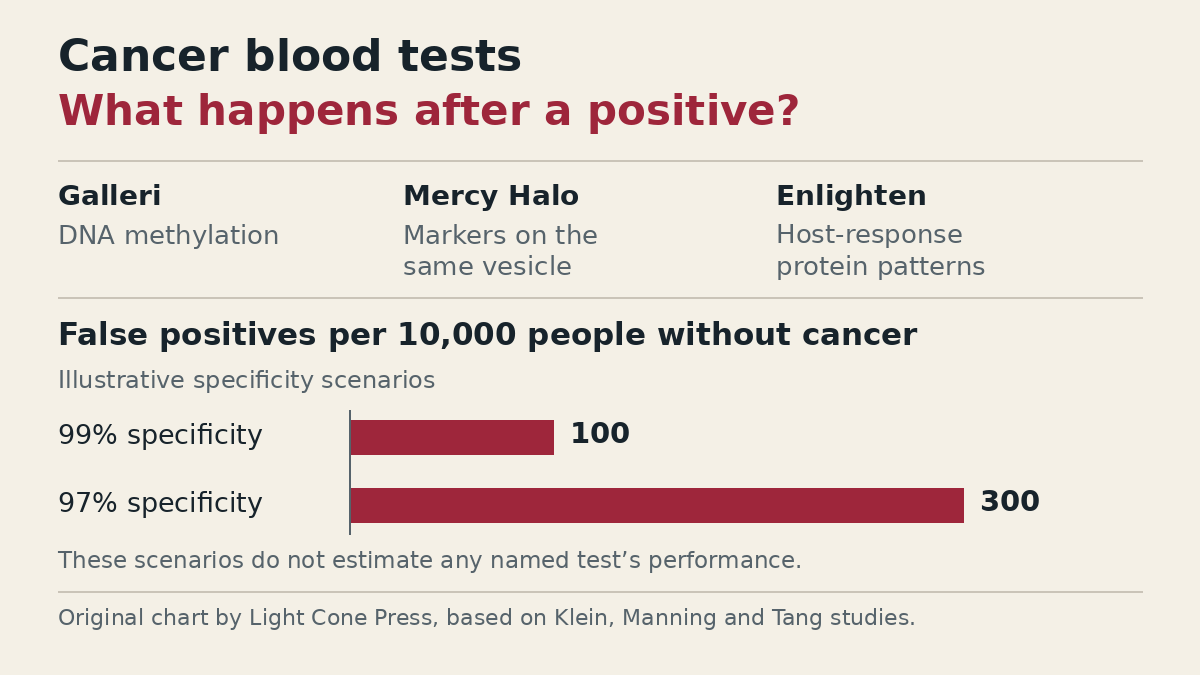
The NHS referral trial raises an economic question. Could a simpler blood test help GPs get more patients with cancer to the right investigation sooner? Galleri reads methylation patterns on DNA fragments. Mercy’s Halo looks for several markers on the same extracellular vesicle, a small particle released by cells. Proteotype’s Enlighten uses fluorescence to look for changes across the patient’s plasma proteins. The vesicle and protein approaches offer other signals to investigate when little tumor DNA reaches the bloodstream.
The numbers answer different questions. Galleri’s validation detected 16.8% of stage I cancers across the cancers studied, at 99.5% specificity. In a blinded study of stored blood collected before diagnosis, Mercy’s ovarian assay detected eight of nine stage I or II high-grade serous cancers within a year of diagnosis. Its specificity was 97.7% across 1,176 controls. Enlighten’s proof of concept reported 78% sensitivity across four cancer types in a mixed-stage cohort, with zero false positives among 20 healthy controls. Most cancer cases in that proof of concept were metastatic. The three studies used different populations and cancer mixes.
False positives can erase a saving in the lab. At 99% specificity, 100 of every 10,000 people without cancer would test positive. At 97%, that number triples. In the prospective PATHFINDER screening study, false-positive results took a median 162 days to resolve. Knowing where to look can help focus the work-up. Galleri’s validation correctly predicted the likely origin in 88.7% of true positives. Mercy’s ovarian study evaluated a single cancer. MODERNISED is evaluating Enlighten’s ability to locate cancers and includes people with symptoms whose investigations ruled cancer out.
Halo’s PCR readout and Enlighten’s fluorescence assay could lower lab costs. Public prices give limited guidance. Galleri lists for $949 in the U.S. and Mercy’s separately marketed Evident ovarian test lists for $795. Those are retail prices. The costs of running the assays and the prices the NHS might pay are separate questions. Proteotype’s INNOVATOR study is comparing capillary and venous samples to see whether blood collected at home could support a future lab-based test. Running an assay in regional labs would also require evidence that results are consistent across sites.
Established players have room to adapt. Exact Sciences already combines DNA methylation with protein markers in Cancerguard. In July 2026, the FDA approved a change to Guardant’s Shield classifier that removed fragmentation and mutation signals in favor of methylation alone. Adding a biomarker is useful if it changes who gets referred or where clinicians look next.
Sequencing serves a separate purpose when clinicians need to track tumor mutations after treatment, as in Natera’s Signatera CDx, or identify mutations that guide treatment, as in Guardant360 Liquid CDx. For the NHS, the measure that matters is whether adding a blood test to GP assessment speeds up the right referrals at a cost the system can sustain.
ORIGINAL SOURCES
- Related perspective on the NHS referral trial
- University of Birmingham, STRIDE-RCT trial announcement
- Klein et al., Galleri methylation validation, Annals of Oncology
- Manning et al., blinded UKCTOCS nested case-control study, Gynecologic Oncology
- Tang et al., host-response biomarker proof of concept, Nature Communications
- Schrag et al., PATHFINDER prospective screening cohort, The Lancet
- ISRCTN registry, MODERNISED study design and outcomes
- GRAIL, Galleri U.S. list price
- Mercy BioAnalytics, Evident U.S. list price
- Proteotype, INNOVATOR paired-sample study announcement
- Exact Sciences, Cancerguard biomarker classes
- FDA, Shield methylation-only workflow supplement, July 22, 2026
- FDA, Signatera CDx indication and tumor-informed assay
- FDA, Guardant360 Liquid CDx indication and assay