PERSPECTIVE
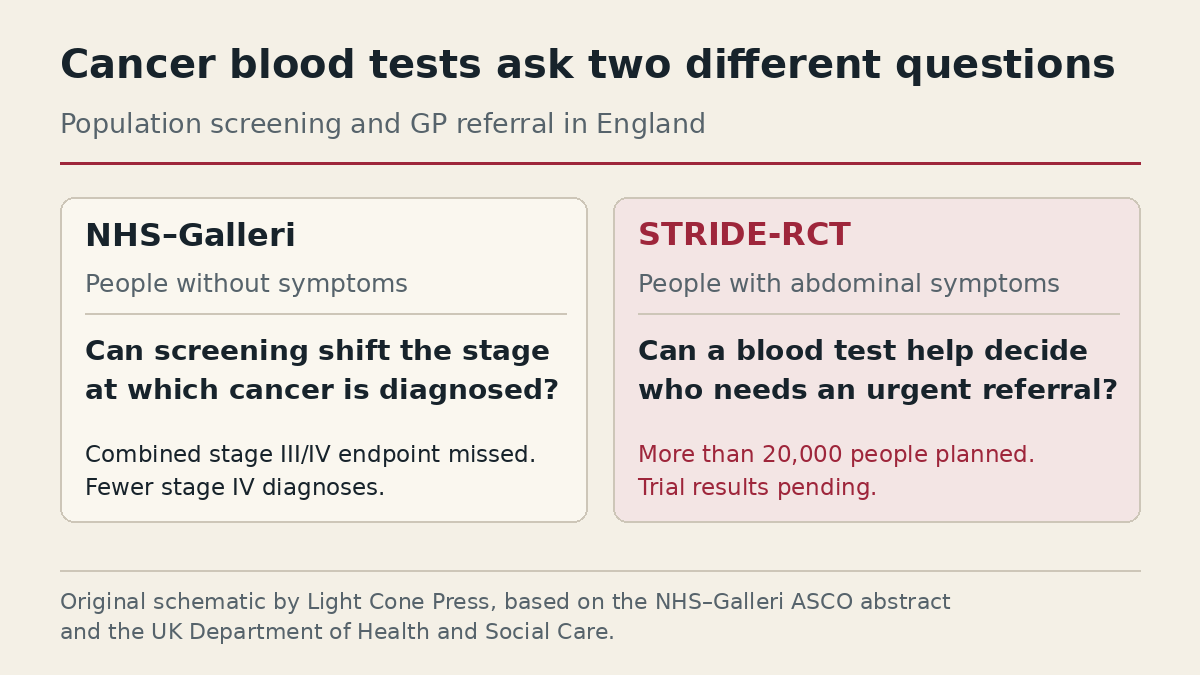
On November 10, Mercy BioAnalytics confirmed its selection for STRIDE-RCT, a University of Birmingham-led trial that plans to enroll more than 20,000 people across at least 200 GP practices in England. Proteotype’s Enlighten test was also selected. The study will ask whether blood results help GPs decide who needs urgent investigation for possible cancer when symptoms such as persistent bloating could have several causes.
The NHS-Galleri trial asked a different question. It added GRAIL’s blood test to routine screening for people without symptoms. The trial missed its primary endpoint of reducing stage III and IV diagnoses combined across 12 prespecified cancers. Stage IV diagnoses alone were 14% lower, a secondary finding. Whether screening reduces cancer deaths remains open.
That distinction surfaced at the FDA’s September 23 advisory hearing. The panel voted 6–4 in favor of Galleri’s effectiveness, but some members who voted yes wanted “early” removed from the proposed indication and called for further study. The vote was advisory. A test can find a cancer sooner than it would otherwise present, even if it is already advanced.
Galleri reads methylation patterns, or chemical marks, on DNA fragments circulating in blood. Mercy BioAnalytics’ Halo platform looks for combinations of cancer-associated markers on the surface of the same extracellular vesicle, a tiny membrane-bound particle released by cells. Healthy cells also release vesicles, so looking for markers together can help distinguish tumor-associated vesicles from that background. In the published assay, DNA tags on antibodies that bind near each other generate a signal that can be measured by PCR. Mercy says its STRIDE-RCT test draws on this platform.
Proteotype’s Enlighten looks for changes in the patient’s own blood proteins. Its fluorescence assay measures selected amino-acid residues across plasma proteins, and a machine-learning model looks for a pattern associated with the body’s response to cancer. Both platforms give researchers a way to look for a cancer signal when little tumor DNA reaches the bloodstream.
In a small proof-of-concept study, the research classifier flagged 60 of 77 samples from patients with known cancer and returned no positives among 20 healthy controls. The researchers also found differences in biomarker patterns in small groups of people with infections or autoimmune disease. How often the test would flag people who have similar abdominal symptoms for other reasons remains an open question. The separate MODERNISED study completed enrollment of 1,350 people, including symptomatic patients in whom cancer was ruled out.
The field already spans different uses. Exact Sciences markets Cancerguard to look for signals from multiple cancers, while Guardant’s FDA-approved Shield screens for colorectal cancer. For STRIDE-RCT, the practical question is whether a blood result gets the right symptomatic patients to diagnostic work-up sooner. A positive signal still needs confirmation.
ORIGINAL SOURCES
- Mercy BioAnalytics selection announcement, November 10, 2026
- UK Department of Health and Social Care, STRIDE-RCT announcement
- Trinity Hall, Cambridge, Proteotype participation
- NHS-Galleri randomized trial, ASCO 2026 primary results abstract
- FDA advisory panel official meeting summary, September 23, 2026
- Exact Sciences, Cancerguard intended use
- FDA, Guardant Shield approval and intended use
- Klein et al., clinical validation of a targeted methylation-based multicancer test
- Tang et al., Enlighten biomarker proof of concept, Nature Communications
- Wilding et al., MODERNISED study protocol, BMJ Open
- Southampton Clinical Trials Unit, MODERNISED recruitment completion
- Salem et al., Mercy Halo single-vesicle assay proof of concept, Journal of Molecular Diagnostics