PERSPECTIVE
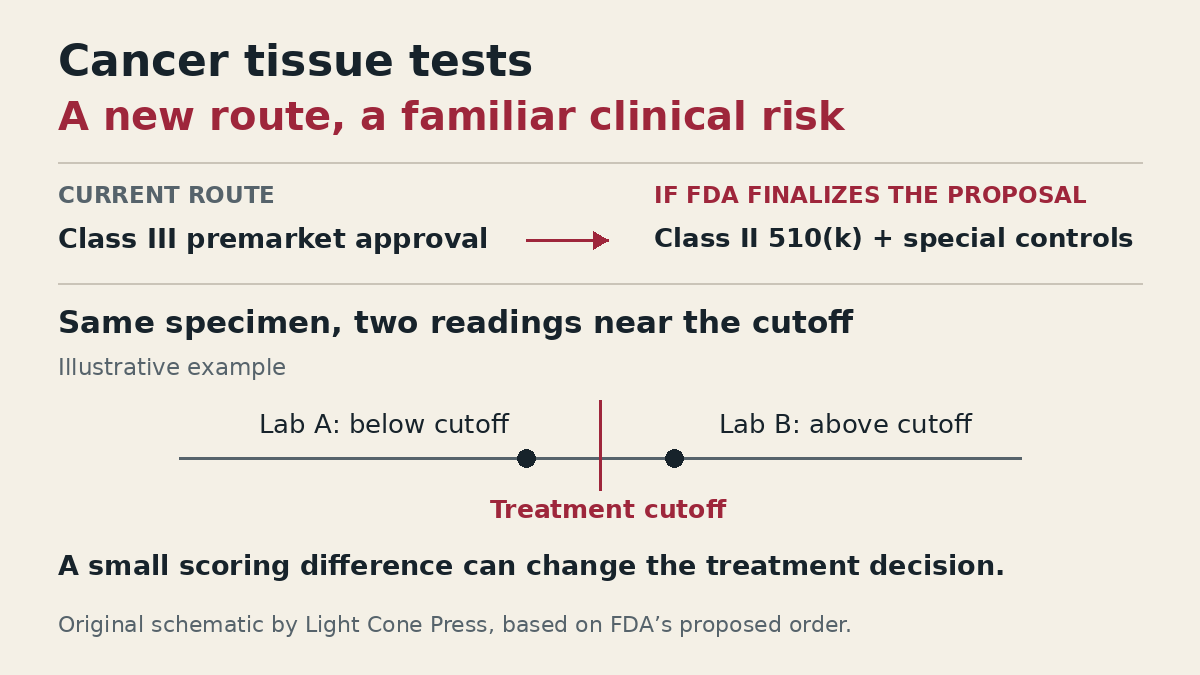
On November 12, the FDA proposed moving certain immunohistochemistry (IHC) tests used with approved cancer drugs from Class III premarket approval to Class II review. IHC uses antibodies to stain proteins in tissue. A pathologist’s score can help determine which treatment a patient is eligible to receive. The proposal follows a separate final order for certain in situ hybridization tests, which took effect September 16.
The most immediate opportunity is for a developer targeting an established use. If the IHC order is finalized, a developer could seek 510(k) clearance by showing substantial equivalence to a legally marketed comparator, known as a predicate. The FDA expects the route to be less burdensome and typically quicker than premarket approval. The proposed controls still call for clinical performance data from specimens representative of the intended population. The agency cites a comparison with an appropriate FDA-authorized test or use of the assay in the drug trial as possible sources of evidence.
PD-L1 illustrates why the comparator matters. In the Blueprint study of lung cancer specimens, three of five assays stained tumor cells similarly, while the other two showed different staining sensitivity. Agreement among pathologists was also much weaker when scoring immune cells than tumor cells. Near a treatment cutoff, a small difference in staining or scoring can put the same specimen on the other side of the threshold. The proposed controls call for testing borderline specimens and assessing reproducibility across factors such as reagent lots, instruments and readers. They also call for evidence across sites when the test is intended for use at multiple sites.
For a drugmaker, another assay cleared for the relevant use could give more labs a practical way to offer testing on equipment they already run. That opportunity depends on the specific test configuration, evidence and labeling. A lab would still need to check which instruments and uses the clearance covers, and clinicians would still follow the drug’s biomarker requirements. The competitive opening is most concrete where a developer can match an established clinical use and make the test easier for labs to adopt. The IHC proposal covers 12 product codes, and comments are due January 11, 2027.
ORIGINAL SOURCES
- FDA proposed order, published November 12, 2026
- FDA list of authorized companion diagnostics
- FDA final order for certain oncology in situ hybridization tests, effective September 16, 2026
- FDA, premarket notification and substantial equivalence
- Tsao et al., Blueprint Phase 2 comparison of PD-L1 assays in lung cancer specimens